

Cold Plunge vs CRYO: Why the Right Recovery Choice Depends on Your Goals
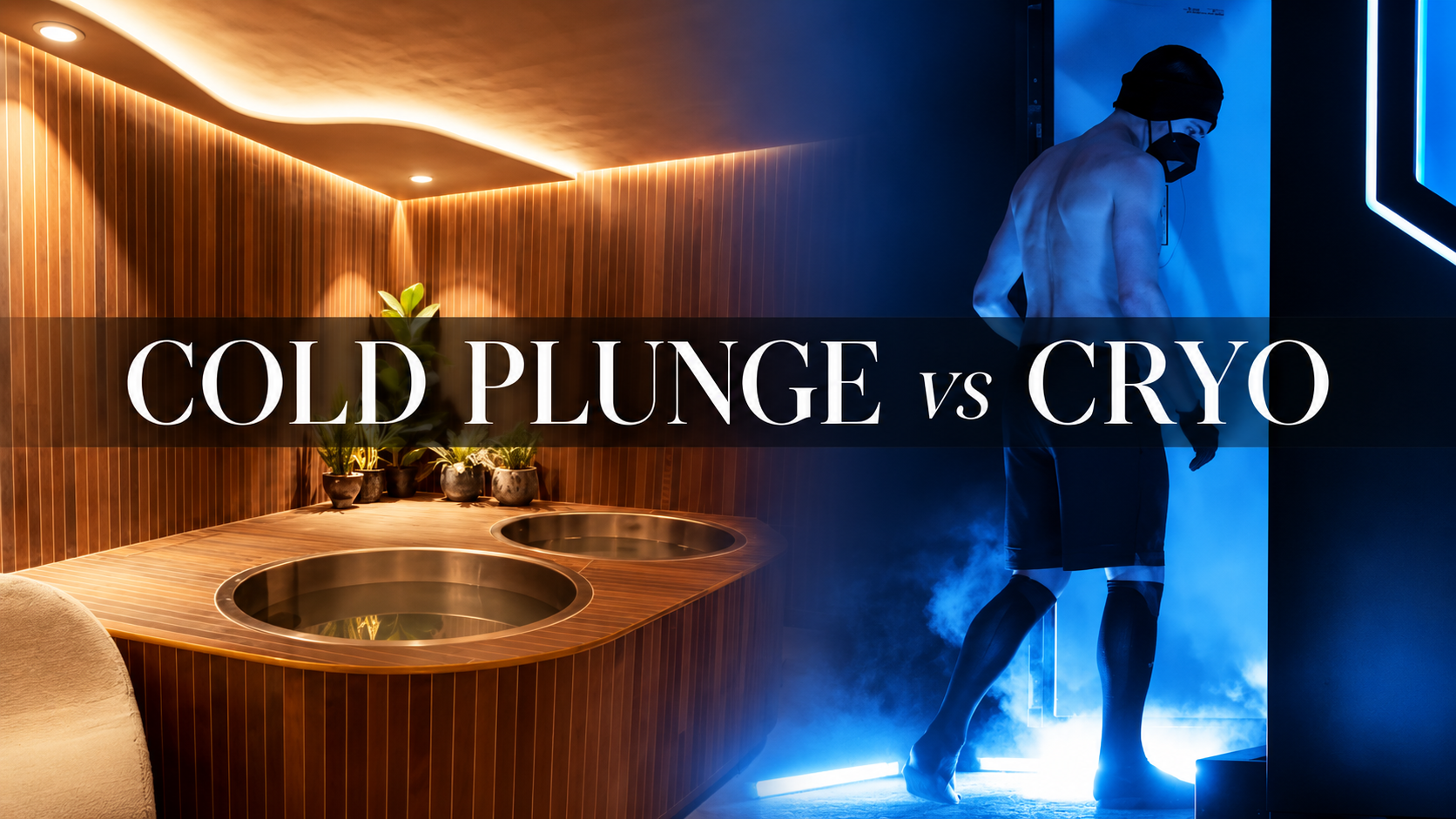
Recovery Is Nuanced: Let Science Guide You, Not Trends
Cold plunges are having a moment.
Scroll through any feed and you will see ice baths framed as the ultimate recovery tool. Cold water immersion can help reduce perceived soreness and may be useful when an athlete needs to feel ready for another session soon.
But the science is more nuanced than the hype. Choosing a cold therapy is not simply a matter of following a trend or picking the least expensive option. What is the client's goal? Why are they using cold exposure? And when does it fit into their training? Personalisation matters, especially when you want clients to see value and return.
A [2024 systematic review and meta-analysis](https://onlinelibrary.wiley.com/doi/10.1002/ejsc.12074) found that cold water immersion immediately after resistance training may modestly reduce gains in muscle size over time. That does not mean an occasional plunge erases a workout, and the findings do not establish what happens when cold exposure is delayed by several hours. But for clients whose priority is muscle growth, routinely plunging straight after lifting deserves a rethink.
One possible explanation is that substantial cooling soon after exercise can interfere with some of the processes involved in muscle adaptation. The exact contribution of each mechanism is still being studied. Effects on strength are less consistent than those on muscle size, so it is important to be precise about the goal.
This is where whole-body cryotherapy deserves a closer look.
Unlike a 10–15 minute cold plunge, cryotherapy involves much shorter exposure (typically 2–4 minutes) in extremely cold air. Air transfers heat far less efficiently than water so the depth & duration of intramuscular cooling is generally lower. Current evidence does not show the same clear attenuation of hypertrophy that we see with cold-water immersion. For some clients, that’s optimal.
For athletes and lifters prioritising strength and muscle growth, cryotherapy is the tool of choice.
Practical differentiation:
• Strength + hypertrophy focus → Prefer cryotherapy (or substantially delayed cold exposure) after lifting. Avoid regular immediate plunges.
• Cardio / general recovery → Cold plunges remain a solid good choice.
• Endurance performance in heat conditions → Pre-cooling (of various forms) has stronger support. aIr extends the point at which muscle is working strongly before overheating.
Cold exposure is a tool, not a dogma. The best choice depends on the training goal, the timing, & the modality. Clinics or gyms offering contrast therapy or cold therapy should know the goals of the client and adjust accordingly. Recovery should always be bespoke and I worry most centres offer a 1 dimensional, 1-Size-Fits-All approach.
Cold exposure is a tool, not a rule. The right choice depends on the goal, the timing, the type of exposure and the individual's response. Clinics and gyms offering cold or contrast therapies should start by understanding what each client wants to achieve. Recovery deserves more than a one-size-fits-all protocol.
Science should lead the protocol, not trends.